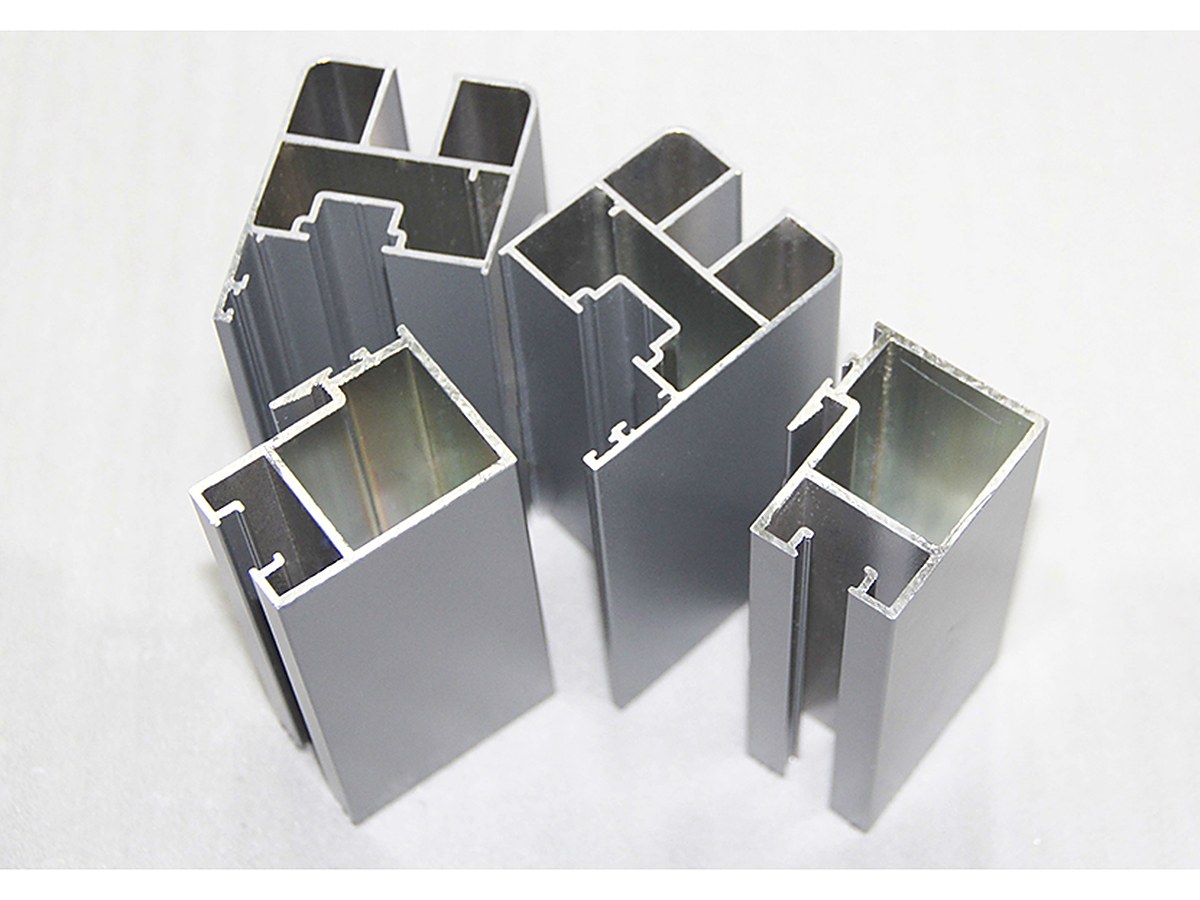
Writing '6063-T5 aluminium profile, coated finish' on an RFQ sounds complete and says almost nothing. Anodised, electrodeposition-coated, powder-coated, paint-coated and thermal-barrier profiles each carry a different set of acceptance criteria, test items and warranty terms. Worse, the film-thickness comparison tables circulating online contradict one another, so copying a number into a contract is a reliable way to create a dispute at incoming inspection. This guide follows the order a buyer actually works in: which documents make up GB/T 5237, what each finish family is for, which numbers must not be copied, and a checklist that can be pasted straight into an enquiry and an inspection form.
On the national standards information platform, the current edition of GB/T 5237 is the 2017 series. Each of the six parts has its own number and title, and all six were published on 14 October 2017. Parts 1, 2, 3, 5 and 6 took effect on 1 July 2018; Part 4 took effect on 1 May 2018. Referring to 'GB/T 5237-2017 Architectural Aluminium Profiles' as a single document is a common and costly error in purchasing paperwork, and one that reviewers routinely send back.
| Part | Official title | What it governs |
|---|---|---|
| GB/T 5237.1-2017 | Part 1: Base profiles | Alloy designation, temper, chemistry, dimensional tolerance, mechanical properties |
| GB/T 5237.2-2017 | Part 2: Anodized profiles | Anodic film thickness grades, sealing quality, appearance, corrosion resistance |
| GB/T 5237.3-2017 | Part 3: Electrodeposition coating profiles | Composite film of anodic oxide plus electrophoretic lacquer |
| GB/T 5237.4-2017 | Part 4: Powder coating profiles | Thermoset powder coating |
| GB/T 5237.5-2017 | Part 5: Paint coating profiles | Liquid paint systems, including fluorocarbon coatings |
| GB/T 5237.6-2017 | Part 6: Thermal barrier profiles | Inserted-strip and poured-and-debridged construction |
Two titles are misquoted constantly. Part 4 is officially 'Powder coating profiles' and Part 5 is 'Paint coating profiles'; the 2008 edition of Part 5 was indeed titled fluorocarbon-paint sprayed profiles, but the 2017 edition fully replaced it and broadened the scope. A contract that still cites GB/T 5237.5-2008 points at a withdrawn standard. One more correction: some online buying guides tell you to check a '3C certificate' for aluminium profiles. Architectural extrusions are not in the mandatory product certification catalogue. At goods receipt the documents that matter are the certificate of conformity, the quality certificate and the test report.
An oxide layer is grown from the aluminium itself, so the metallic character is preserved and the dimensional impact is minimal. Colours are limited to silver, bronze, black and similar tones, and the surface resists wiping and abrasion well. It suits visible interior elements and projects where a genuine metal appearance is required. Because batch-to-batch tone can drift, agree a sealed sample and a batch consistency clause before production.
A lacquer layer is deposited over the anodic film, forming a composite coating. The result is more uniform than plain anodizing, more resistant to fingerprints and staining, and available in a wider gloss range. It fits windows and decorative profiles where appearance consistency matters more than a thick coating.
Electrostatic powder coating offers the widest colour and texture choice, including wood-grain transfer, at manageable cost. It is the default for exposed window, door and railing profiles. Specify the powder chemistry, colour code, gloss level, adhesion and weathering test items, and define explicitly which faces count as decorative.
Liquid coating systems with two, three or more coats are selected against the standard and the project documents. Fluorocarbon systems are typically chosen for high-durability facades and curtain walls. The decision should rest on exposure category, design service life and an approved sample, not on the assumption that more coats are always better.
Strictly speaking this is not a finish but a structural composite, either a polyamide strip inserted between two extrusions or a poured polymer channel. It determines the thermal path of the whole window, so the strip material and geometry need separate verification; polyamide strips, for example, are covered by GB/T 23615.1-2017. Treating the thermal break as a 'finish option' on the enquiry is one of the most frequent omissions.
Open two industry articles at random and the numbers collide. Anodized exterior profiles are quoted as 'Class A, at least 12 micrometres' in one and 'AA15, average at least 15 micrometres' in another. Powder coating appears as 'decorative face at least 50 micrometres', 'local minimum 40 micrometres' and 'average 60 micrometres'. Three-coat paint systems appear as 30, 34 and 40 micrometres. Most of these figures never say whether they come from the standard text, a specific test condition or a factory's internal target. They also tend to treat 'exterior versus interior' as a universal grading rule, ignoring the exposure category and the project specification. Marketing phrases such as '15 to 20 years of weatherability' are worse: they cannot be tested and cannot be enforced.
There is a defensible three-step alternative. First, put the grade designation in the contract, chosen from the relevant part of the standard and the purchaser's requirements rather than as a bare thickness figure. Second, put measured values in the test report: film or coating thickness, adhesion, sealing quality and weathering results issued under the test methods specified in the standard, with CMA or CNAS accreditation and full specimen details. Third, put the decision rule in the acceptance clause: sampling lot, judgement group, retest procedure and nonconformance handling. The numbers themselves come from the standard text and the project technical documents, never from a search snippet.
For window and facade work, start with our window and door profiles and thermal-break casement profiles. Inserted-strip systems need a separate check of the polyamide thermal break strips, and where a fluorocarbon-painted facade is involved, align the colour and weathering requirements of the PVDF-coated aluminium veneer at the same time. If the section is not fixed or is non-standard, use the contact page to send drawings with the enquiry; that produces a far more useful answer than comparing a price per metre.
| Check | What to look at | Action on failure |
|---|---|---|
| Documents | Model, lot, part number and grade designation against the contract | Hold unloading; obtain documents or replace |
| Appearance | Colour drift, scratches, runs, orange peel, end burrs, compared with the sealed sample | Quarantine the lot and judge by batch |
| Dimensions | Critical section dimensions, wall thickness, bow and twist, measured to drawing and tolerance grade | Segregate out-of-tolerance pieces, then retest |
| Film and coating | Thickness records, adhesion, sealing quality, third-party report cross-check | Witnessed sampling and laboratory judgement |
| Marking and traceability | Certificate, lot number, package label and packing list all matching | Reject any lot that cannot be traced |
Record measured values and the pass or fail decision, never 'visually acceptable'. Log the gauge model, measuring positions, sample size and judgement basis. If colour drift or coating failure appears six months later, that record lets you go back to a specific lot rather than to a verbal assurance nobody can reconstruct.
No. The series has six parts. State the part, the grade designation and the edition. Naming only the series lets a supplier deliver to the loosest plausible reading.
Not automatically. Appearance, corrosion mechanism, test items and repair methods all differ. A substitution is a design change and needs a new sample, a new report and a revised contract annex.
No. The coating system must match exposure category, design service life and budget, and must be fixed under Part 5 and the project documents. Adding coats raises cost and can introduce adhesion or flexibility risks.
Colour, gloss and texture cannot be defined precisely in words. A sealed sample is the only object that can be compared again at delivery, at retest and on a later top-up order. Without it, a colour dispute is effectively undecidable.
Yes. Part 6 governs the composite profile's construction and performance, while the strip material has its own standard. Request both sets of documents and match them to the same lot.

GB/T 5237.6-2017 and GB/T 23615.1-2017 govern two different goods. Read both markings before you sign the packing list.
Read more
QB/T 2698-2024 covers overhead closers and excludes fire door closers. QB/T 2697-2024 covers floor springs. Fix the scope first.
Read more
How to name the exact AAMA and GB/T edition on an aluminium finish enquiry, and what the 2026 FGIA revisions changed in the specification line.
Read moreSend us the categories, models or opening sizes you need. We will organise the configuration and quotation, in Chinese or English.