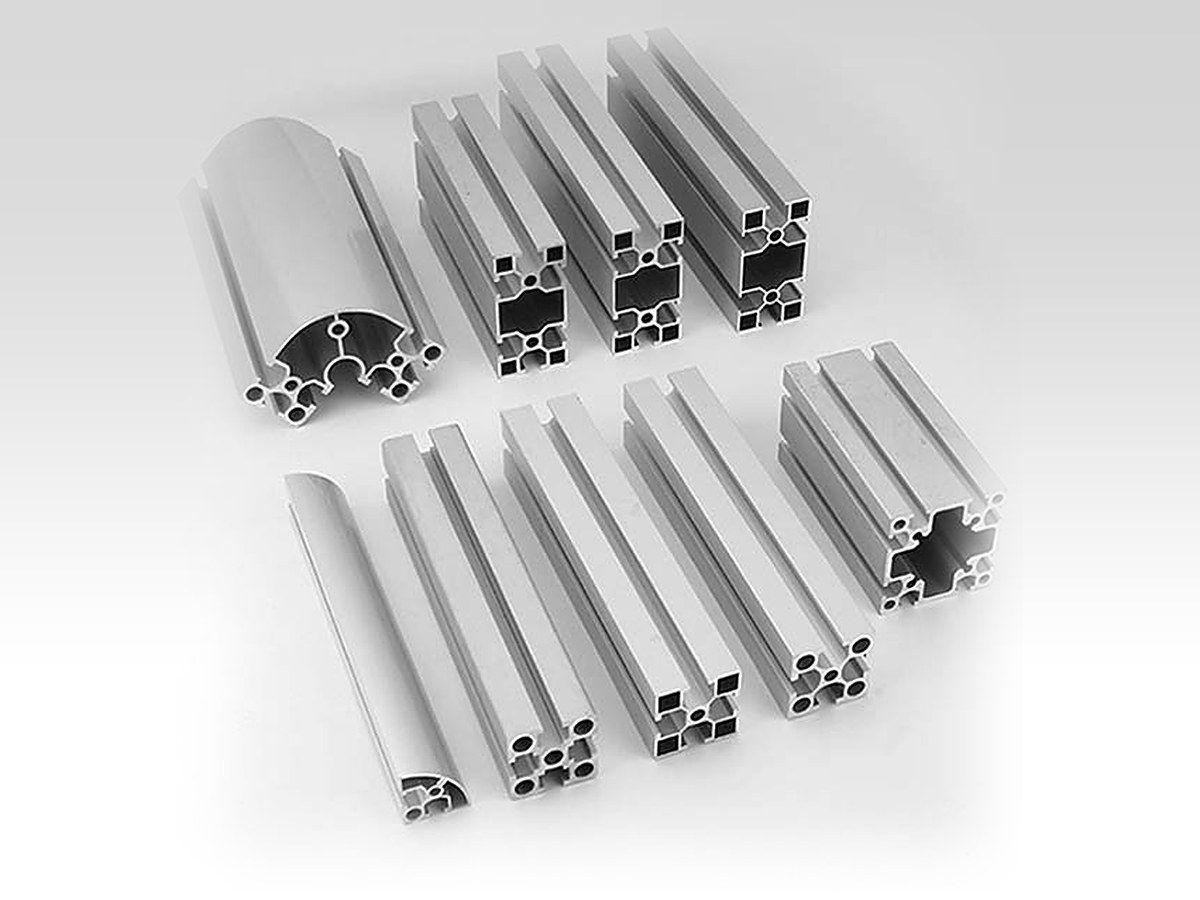
Industrial aluminium profiles are T-slotted extrusions used for machine frames, conveyors, guards and automation workstations. They are specified by four groups of dimensions: section series, slot width and slot geometry, wall thickness, and cut length. Getting these wrong is the most common reason a frame arrives with connectors that do not fit. This guide follows the order a buyer actually needs, and ends with a checklist you can paste into an RFQ.
The series number usually refers to the base section size in millimetres: a 40-series family includes 40×40, 40×80 and 40×120 sections. The table below is the industry convention, not a single mandatory national numbering system. Catalogues differ between suppliers, so the drawing always wins.
| Series | Typical sections (mm) | Common slot | Typical use |
|---|---|---|---|
| 20 | 20×20 / 20×40 | 5-6 mm | Light frames, instrument stands, small guards |
| 30 | 30×30 / 30×60 | 6-8 mm | Medium frames, control-cabinet skeletons |
| 40 | 40×40 / 40×80 / 40×120 | 8-10 mm | General machine frames, conveyors, benches |
| 45 | 45×45 / 45×90 | 10 mm | Automation equipment, robot fencing |
| 60 / 80 | 60×60 / 60×120 / 80×80 | 10 mm and above | Heavy equipment, gantries, load-bearing frames |
Do not upsize on instinct. A larger section increases stiffness and adds material, machining time and freight. Portable equipment and anything that has to be lifted by hand often performs better with a smaller section plus sensible bracing.
The longitudinal groove takes T-nuts, brackets, connectors and panels. Common slot widths are 6, 8 and 10 mm, matched to M5 / M6 / M8 fastener families. T-slot sections (often called B-type or I-type depending on the catalogue) serve general framing; V-slot sections are designed for linear motion, wheels and guides. Different slot geometries can exist inside the same nominal series, so profiles with the same name are not interchangeable unless the slot system matches. Mixing two suppliers' catalogues without checking this is the classic cause of rework.
Your RFQ therefore needs series, slot width, slot geometry (or the section drawing) and the T-nut size. Writing only '4040 profile' is not a specification.
Most industrial extrusions use 6063-T5 or 6061-T6. 6063-T5 extrudes readily and anodises with a consistent finish, which suits frames and visible parts; 6061-T6 offers higher strength for loaded members and machined connectors. General framing sections commonly fall in the 1.5-3.0 mm wall-thickness range. Thicker walls improve local load capacity and thread engagement; thinner walls save weight and cost.
Wall thickness alone does not give you a load rating. Capacity depends on the section's moment of inertia, span, load direction (bending, torsion, compression), joint design and support conditions. Any table quoting a fixed 'kg per metre' capacity should be treated as marketing unless the calculation basis and test report are supplied.
Extrusions leave the press in bars of roughly 5.8-6.0 m. Distributors commonly offer cut lengths of 500, 1000, 1500, 2000 and 3000 mm. Short lengths are easier to handle and cheaper to ship; long bars suit batch machining. Estimate theoretical weight as:
Weight (kg/m) ≈ cross-sectional area (mm²) × 2.7 × 10⁻⁶
where 2.7 is the density of aluminium in g/cm³ converted to kg/mm³. A typical 40×40 section lands around 1.5-1.7 kg/m, but the figure moves with slot geometry and wall thickness. When a quotation is priced by weight, agree the theoretical weight from the section drawing. Never estimate it from the series number.
If parts will later be bonded, grounded or welded, state the finishing sequence before ordering; a coating can become a process obstacle.
With these eight items, quotes become comparable and you avoid the hidden cost of a profile that is 10% cheaper but takes nobody's connectors.
Yes. It balances stiffness, weight and accessory availability, so most general frames, benches and guards start at the 40 series. Drop to 20/30 for light stands; move to 60/80 for heavy frames.
Only when series, slot width, slot geometry and connector families match. Check section drawings and sample fasteners before assembly, not just the model name.
No. Around 6 m is simply the normal press and shipping length. Most suppliers cut to drawing, and volume orders can be planned around the most economical cut length.
INLINK supplies industrial extrusions, frame and cable-rack profiles, heat-sink sections and window / curtain-wall profiles, with cut-to-length, machining and finishing to drawing. See industrial profiles, frames and cable racks, or send us your section drawing for a quote.

GB/T 5237.6-2017 and GB/T 23615.1-2017 govern two different goods. Read both markings before you sign the packing list.
Read more
QB/T 2698-2024 covers overhead closers and excludes fire door closers. QB/T 2697-2024 covers floor springs. Fix the scope first.
Read more
How to name the exact AAMA and GB/T edition on an aluminium finish enquiry, and what the 2026 FGIA revisions changed in the specification line.
Read moreSend us the categories, models or opening sizes you need. We will organise the configuration and quotation, in Chinese or English.