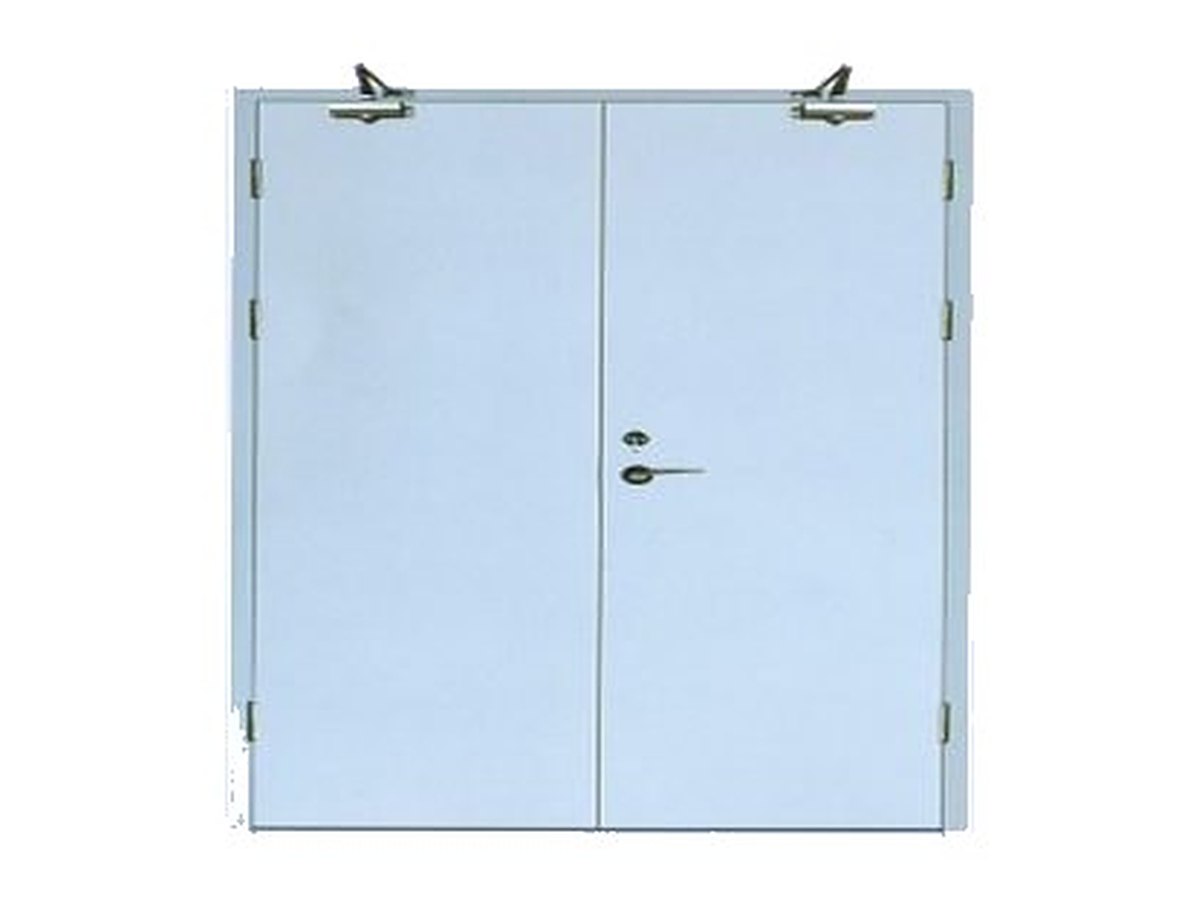
A normally-closed fire door usually fails because someone wedged it open. A normally-open fire door fails somewhere you cannot see: the doorset is compliant, the closer is fitted, but the alarm signal never releases the hold-open device, or the leaf closes with no status ever reaching the fire control room. These doors are held open in everyday use by an electromagnetic release or an electric closer, and in a fire the linkage system has to take over. What you are accepting is therefore not a single doorset but a chain running from a detector to the control room. Since 1 May 2026, GB 12955-2024 Fire-resistant doorsets has been in force, so purchasing and acceptance criteria need to be realigned with it.
The distinction matters: a compliant product does not guarantee a compliant installation, and a compliant installation does not guarantee a working linkage. A contract annex that merely says 'fire doors shall comply with national standards' leaves the most important responsibility undefined.
GB 12955-2024 is not the 2008 text with a new year on the cover. Beyond classification by material and fire performance, it adds classification by application, covering escape routes, plant and equipment rooms and dwelling entrances. It also introduces mechanical performance requirements, requirements for receiving and feeding back linkage signals, smoke-tightness performance, resistance to water spray impact during fire exposure, and tighter environmental requirements for materials. For normally-open doorsets, receiving a signal and reporting a status are, for the first time at product-standard level, part of the specification: the door must close and the control room must know it has closed.
Three things therefore belong in the enquiry: the installation location and application category, the fire performance designation, and the linkage and feedback arrangement. A quotation that says only 'Class A normally-open fire door' will almost certainly attract variations once commissioning starts.
Current equipment-level references include GB 29364-2012, Indicating and control unit for fire resistant doorsets (published 31 December 2012, effective 1 July 2013, still in force, with a revision project under review) and GB 50166-2019, Code for installation and acceptance of fire alarm systems. Buy the monitor, release devices, position switches and electric closers as one coordinated system; having all the boxes on the pallet does not mean they will work together.
Those checklist numbers circulating online, such as a maximum opening force, an exact gap in millimetres or a closing time difference in seconds, rarely say which current clause they came from. The correct approach is to fix the limits by reference to the approved design documents, GB 50877-2014 and the manufacturer's installation instructions, then record measured values and a pass or fail decision. Never promote a blog figure into an acceptance criterion.
A great many buying guides still insist that fire doors must carry mandatory CCC certification. That was the position before 2019. On 16 July 2019 the State Administration for Market Regulation and the Ministry of Emergency Management issued a notice cancelling mandatory certification for part of the fire product catalogue: 13 categories were removed from the CCC catalogue and moved to voluntary certification, with only three groups retained under mandatory certification, namely fire alarm products for public places and dwellings, fire extinguishers, and escape and rescue products. Building fire-resistant components, the category covering fire doors, were among those removed. In a subsequent press Q&A;, SAMR explained that products removed from CCC would remain subject to stronger in-process and ex-post supervision, and that voluntary certification would be encouraged.
Two purchasing consequences follow. First, do not make a mandatory 3C certificate a pass-or-fail condition; that would wrongly exclude compliant suppliers. Second, do not present a voluntary certificate as if it were a mandatory one. What you should request and verify is the type-test report, issued by a qualified laboratory and matching the actual model and fire rating, the certificate of conformity, any voluntary certification the supplier holds, the permanent nameplate and product identity marking, and the incoming inspection and concealed-work records.
| Category | What to match | Common gap |
|---|---|---|
| Product evidence | Type-test report, certificate, nameplate, identity marking and their link to the batch | Report model differs from the installed doorset, or a small-size report is reused for a large opening |
| Linkage evidence | Monitor and accessory documentation, linkage logic description, commissioning records | Only a doorset report is supplied; no commissioning record exists |
| Installation records | Frame fixing and infill, gap treatment, opening direction, concealed-work photographs | Frame gap filled with ordinary foam, no concealed-work images |
| Functional records | Door-by-door manual, automatic, remote and feedback tests with close-out of defects | Only sample testing, when normally-open doors need full coverage |
| Handover | Maintenance instructions, periodic test regime, spares and replacement rules | Closer removed after handover, leaf wedged open, no one accountable |
Hardware belongs on the same checklist: door control hardware, double-leaf steel fire doors, fire-rated window and door hardware and intumescent fire seals are all line items on one acceptance form. When a project needs a mix of normally-open, normally-closed and linked doorsets by location, send the drawings and fire design documents through the contact page; that is a much better basis for a complete schedule than a list of opening sizes.
No. Normally-open doors require proof of automatic closing and status feedback; normally-closed doors are judged on self-closing and on not being held open. The test items differ, so the record forms should differ too.
GB 12955-2024 has been in force since 1 May 2026 and replaced the 2008 edition in full. New contracts should verify product documentation against the new edition, while project-specific requirements still come from the approved design and review comments.
No. Building fire-resistant components were removed from the mandatory certification catalogue in 2019 and moved to voluntary certification. Check the type-test report, certificate of conformity and product identity instead of rejecting on an outdated mandatory-certification requirement.
Linkage depends on each door's wiring, release device and position switch, and installation varies from opening to opening. Test every doorset and file the results by door number; sampling suits documentation and batch appearance checks.
Set up periodic inspection, functional testing and repair records: confirm leaves are not wedged, seals are intact, the monitor shows no faults, and re-verify linkage as the maintenance documents require. Passing a fire acceptance once does not keep a doorset effective for a decade.

GB/T 5237.6-2017 and GB/T 23615.1-2017 govern two different goods. Read both markings before you sign the packing list.
Read more
QB/T 2698-2024 covers overhead closers and excludes fire door closers. QB/T 2697-2024 covers floor springs. Fix the scope first.
Read more
How to name the exact AAMA and GB/T edition on an aluminium finish enquiry, and what the 2026 FGIA revisions changed in the specification line.
Read moreSend us the categories, models or opening sizes you need. We will organise the configuration and quotation, in Chinese or English.